AI is only as good as the context you provide it. A lack of context yields incomplete answers; too much context opens the door to hallucinations.
Stating the obvious for anyone who has been working intensively with AI over the past year. But all the more important to reflect on from time to time.
We are hearing more and more that law firms, private equity firms, and corporates themselves are putting general-purpose AI to work to conduct their due diligence.
Anyone running serious workflows with a general-purpose AI has felt this. The setups that produce useful output are the ones where you have thought carefully about what to feed in, and the results can be genuinely impressive. The question is not whether AI can do due diligence. We have all seen what a well-prompted model can do. The question is where the approach starts to hit its ceiling, and where the limitations are easier to miss than they look.
Four structural problems
If you have already been running due diligence this way, some of what follows will be familiar. None of this is an argument against using AI for due diligence. These are the four limitations that are easy to underestimate from a single impressive run, and harder to ignore once you push past it.
Transparency. If you give a general-purpose AI access to your drive and let it review the documents, it is difficult to verify whether it silently skipped or failed to analyse one of them. You cannot double-check whether it actually went over everything.
Observability. How many contracts has the model reviewed so far? Which risks did it find per document, again? You could build skills or scaffolding that make the model output some kind of tracking file per document or per area of expertise, but that is a lot of work, and good luck reconstructing the picture from fifteen separate conversations afterwards.
Consistency. How do you make sure the model asks the same questions every time? Without control over what gets checked, a general-purpose AI will freestyle its way through the documents, which makes pattern recognition across document types and expertise areas difficult.
Speed. Without pre-structured metadata, a general-purpose AI has to burn tokens querying every date, party, and entity across every document just to locate the right contract. It also has to reconstruct entity relationships from scratch on every query, including resolving alternative commercial names or corporate aliases. That can take minutes per question.
Our choice: focus on a niche process
At Jurimesh, we made this choice early. We focus on a niche process within the legal profession. Why? Several reasons.
Some are obvious. The underlying generative models are getting better by the month. How will you distinguish yourself as a general-purpose AI from the underlying model in the future? Capturing a defined process offers far more opportunities than simply layering AI on top of existing workflows. Solving the overhead of organising and distributing tasks through software is also a valuable asset.
Other reasons are a bit more deliberate. By focusing on a niche process (legal due diligence), we can also concentrate on building in process-specific knowledge.
You can synchronise with as many databases as you like: case law, legislation, and beyond. But the pragmatic knowledge and approach to conducting due diligence in the context of a merger or acquisition is knowledge you have to gather from the field. It is the experience of knowing which legal issue poses an actual risk to the deal, and which one needs resolution but has no real impact on the deal itself.
We have taken this approach since the beginning. We want to build a product with that pragmatic knowledge and experience built in.
The synergy: introducing the Jurimesh MCP
Do we still believe in the power of the underlying generative models, as well as the general-purpose legal AI tools? Absolutely.
That is precisely why we built the Jurimesh MCP. We believe, perhaps just a little more, in the synergy between specialised tools (output substantiated by expertise and verified by end-users) and the general-purpose AI tools that can take the next step within this context.
The output of Jurimesh: analysis runs, findings, reports, chats, Q&A, all directly accessible from your daily legal AI, be it Claude, Legora, Saga, or Harvey.
Back to the four problems
This brings us back to the four problems. Here is how a Jurimesh-fed MCP changes each one in practice.
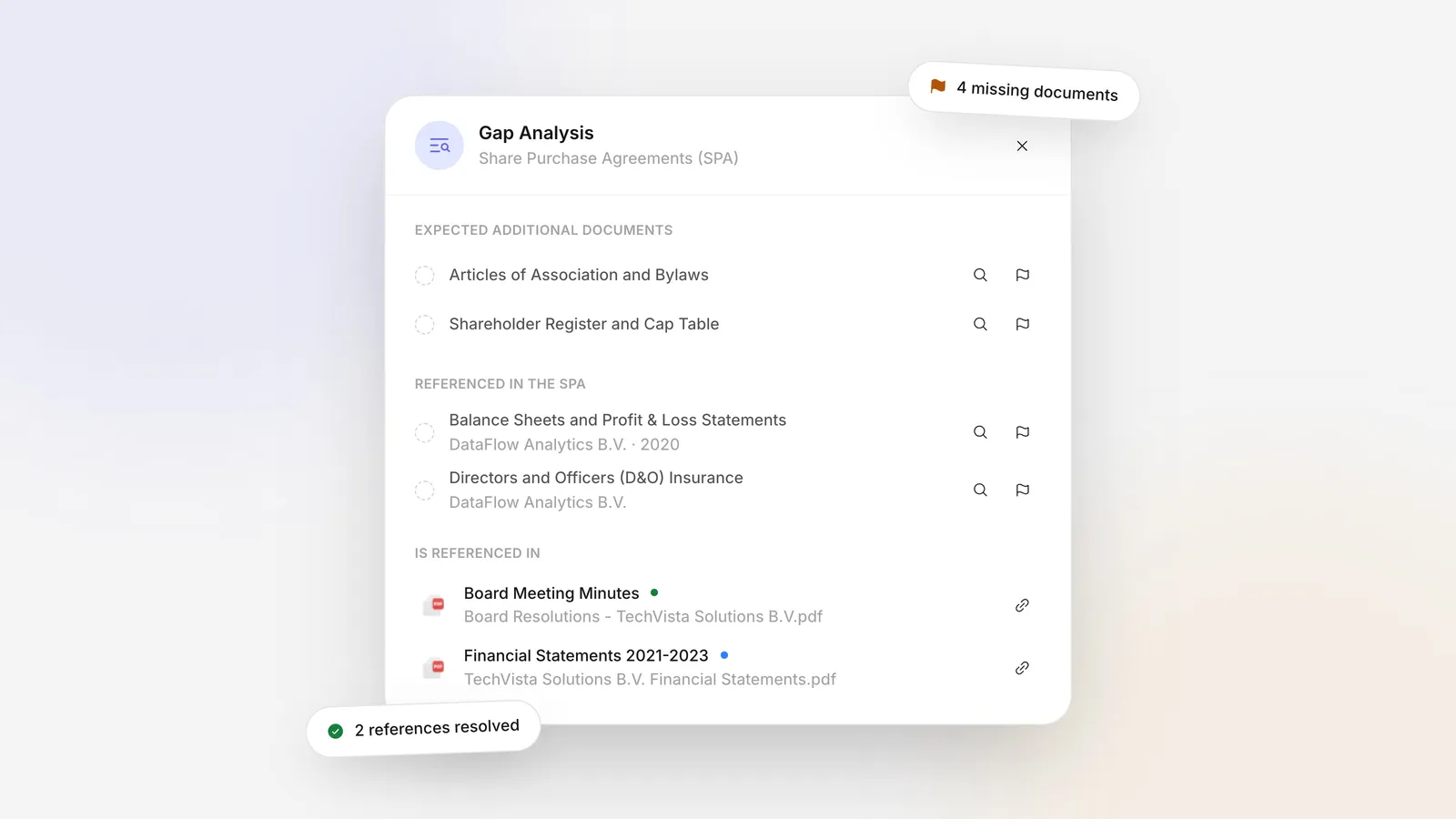
Transparency. Jurimesh keeps an explicit inventory of every document in the dataroom, with a clear status per document and per analysis run. Nothing is silently skipped. When your daily LLM queries that inventory through the MCP, it sees exactly what has been processed, what hasn’t, and what the gaps look like. You can double-check, because there is something concrete to double-check against.
Observability. Findings, risks, and Q&A items live as structured records, not buried in chat history. You can see at any moment how many contracts have been reviewed, which risks were flagged per document, and where the open items sit. The LLM working on top of Jurimesh inherits that visibility instead of having to manufacture it.
Consistency. Because Jurimesh treats every document of the same category in a uniform way, initial analysis results are consistent by design. From that structured base, your LLM can refine the work and spot patterns across a condensed yet uniform layer of information rather than freestyling through every document on its own.
Speed. Jurimesh pre-extracts the metadata that matters most for due diligence (dates, parties, contract categories) and serves it to the LLM through the MCP. The LLM no longer needs to burn tokens querying everything from scratch. Jurimesh also pre-builds a connected graph between documents, linking entities through their alternative commercial names, for example. A query that would have taken a generic model ten minutes to reconstruct gets answered in seconds.
The strongest AI setups we see in due diligence are not the ones with the most data shovelled at the smartest model. It is about pairing a specialised layer that captures domain expertise with a general-purpose layer that knows how to take the next step from there. That is the bet behind Jurimesh, and the reason our MCP exists.