Most due diligence tools scan the context within a single document. Some of the more complex risks can be found somewhere else: in the documents that should be in the data room but aren’t, and in the places where two documents that ought to agree don’t.
Finding those gaps by hand means holding the whole deal in your head, cross-referencing every contract against every other one, and knowing which companion documents each agreement implies. It is slow, and it is exactly the kind of work that gets cut under deadline.
Gap Analysis does it for you. Here is how it works, using a Share Purchase Agreement (SPA) as the example.
1. Expected documents, defined by our experts
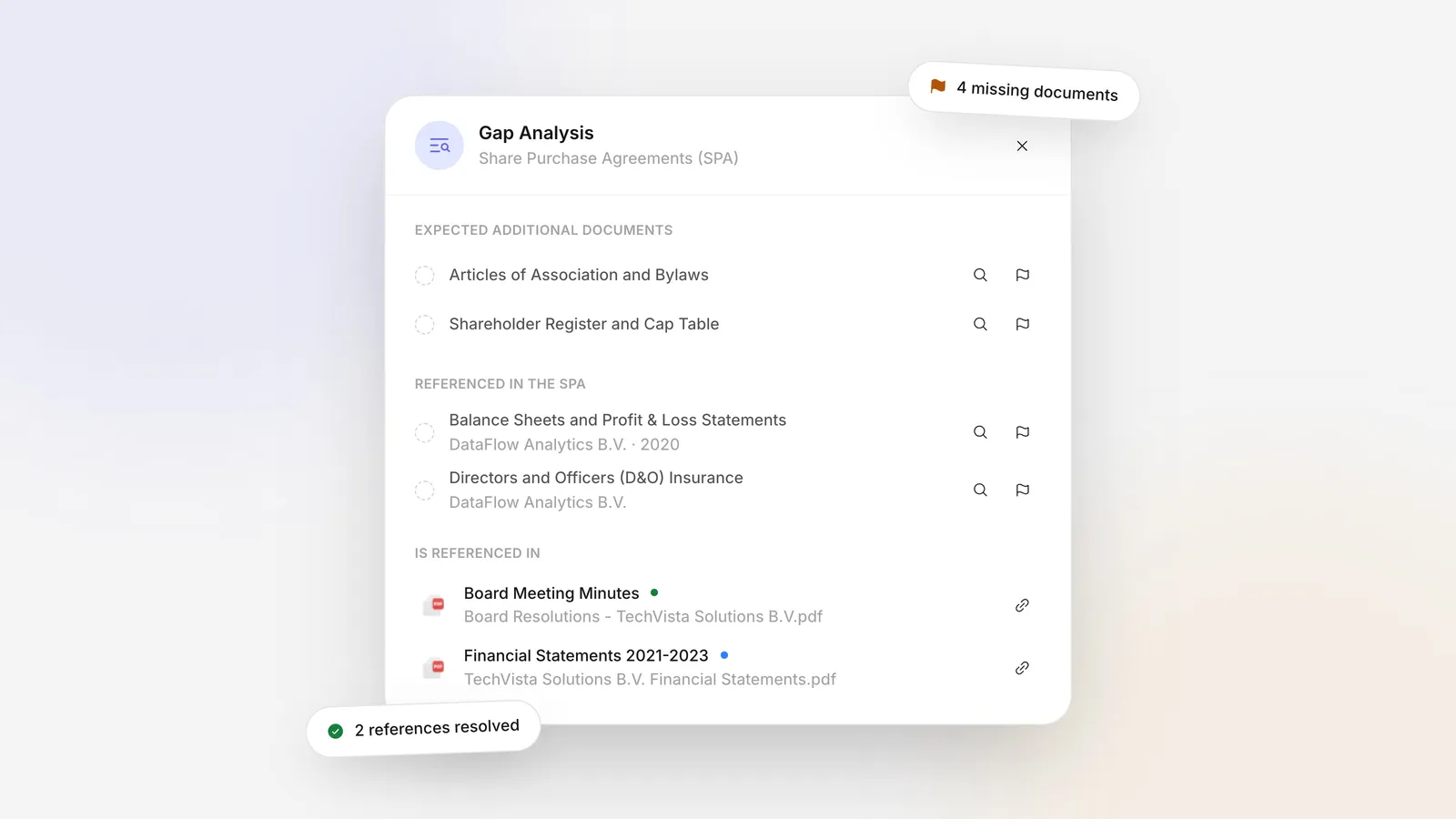
When Jurimesh recognizes a key document, it already knows what other documents belong to it. The specialists who write our risk guides define, per document type, what other documents belong to it to create the most relevant context. For an SPA that means the Articles of Association, shareholder registers, capitalization tables, and share certificates.
Gap Analysis checks the data room for each one and flags anything that is absent.
2. Referenced documents, found or missing
Gap Analysis also reads the document itself and picks up every other legal document that is referenced within. It then searches the data room for each reference and tells you whether it is present.
It works in both directions. You see the documents the SPA refers to, and the documents elsewhere in the data room that refer back to it. The result is the full web of connections around a single agreement, with the missing links called out. When a referenced document comes with a link, you can import it straight into the data room as a PDF, so closing the gap becomes even easier.
3. Compliance between connected documents
Finding the related documents is only half the job. The other half is checking they don’t contradict each other.
For documents that belong together, Gap Analysis compares them. Take the SPA and the Articles of Association: if the Articles require board or shareholder approval before shares can change hands, does the SPA show that approval was given? If it does not, Gap Analysis raises a finding. A contradiction that would otherwise surface late, or never, is on the table early.
What you do with a gap
Every flag is a decision, not a verdict. For each one you can:
- Link the documents together, giving Jurimesh new context to spot further risks.
- Flag it as a finding and raise a Q&A question to the other side, for example to request a missing document.
You stay in control of the call. Gap Analysis simply makes sure nothing slips through unseen.
Now in early access
Gap Analysis is rolling out to a small group of customers first. If you would like to try it on a live deal, request early access or get in touch, and we will set you up.