Let’s take a step back and look at what lies behind the buzzword “agentic.”
Agentic AI, or AI agents, refers to systems built with a greater degree of autonomy; autonomous entities capable of performing a specific task independently.
The technology rests on a few basic principles:
Perception: Agentic AI starts by gathering information from its surroundings and various sources, such as sensors, databases, and user interfaces. This can involve analyzing text, images, or other forms of data to understand the situation.
Reasoning: Using a large language model (LLM), agentic AI analyzes the gathered data to understand the context, identify relevant information, and formulate potential solutions. For example, if the goal is to schedule a meeting, the LLM can parse the text of emails to identify attendees, available times, and the meeting’s purpose.
Planning: The AI then uses the information it has gathered to develop a plan. This involves setting goals, breaking them down into smaller steps, and determining the best way to achieve them.
Action: Based on its plan, the AI takes action. This can involve performing tasks, making decisions, or interacting with other systems.
Reflection: After taking action, the AI evaluates the results. It checks its findings against those of other agents and against the source documents, and uses this feedback to refine its output before the next loop. This cycle of perception, reasoning, planning, action, and reflection repeats until the findings converge into a single, consolidated result.
This continuous cycle allows agentic AI to refine its output within a single analysis, rather than simply producing a one-shot answer.
How does Jurimesh apply this within legal due diligence?
The moment you start a risk analysis in Jurimesh, our specialized AI puts multiple agents to work.
Each agent is equipped with a wealth of legal expertise specific to a particular legal domain and its associated contracts.
These agents examine the documents assigned to them and note any discrepancies they identify.
These notes are then placed side by side and compared with the notes of other agents to arrive at consolidated findings.
This process runs through several loops until all initial findings have been cross-checked, and Jurimesh produces a single, consolidated output for the lawyer to work with. Thanks to this new process, risks are scanned across documents, taking into account contract addenda, emails containing promises to employees, and multiple versions of the same document.
What impact does this have on the output for our users?
- Three times fewer findings
- A significant decrease in false positives
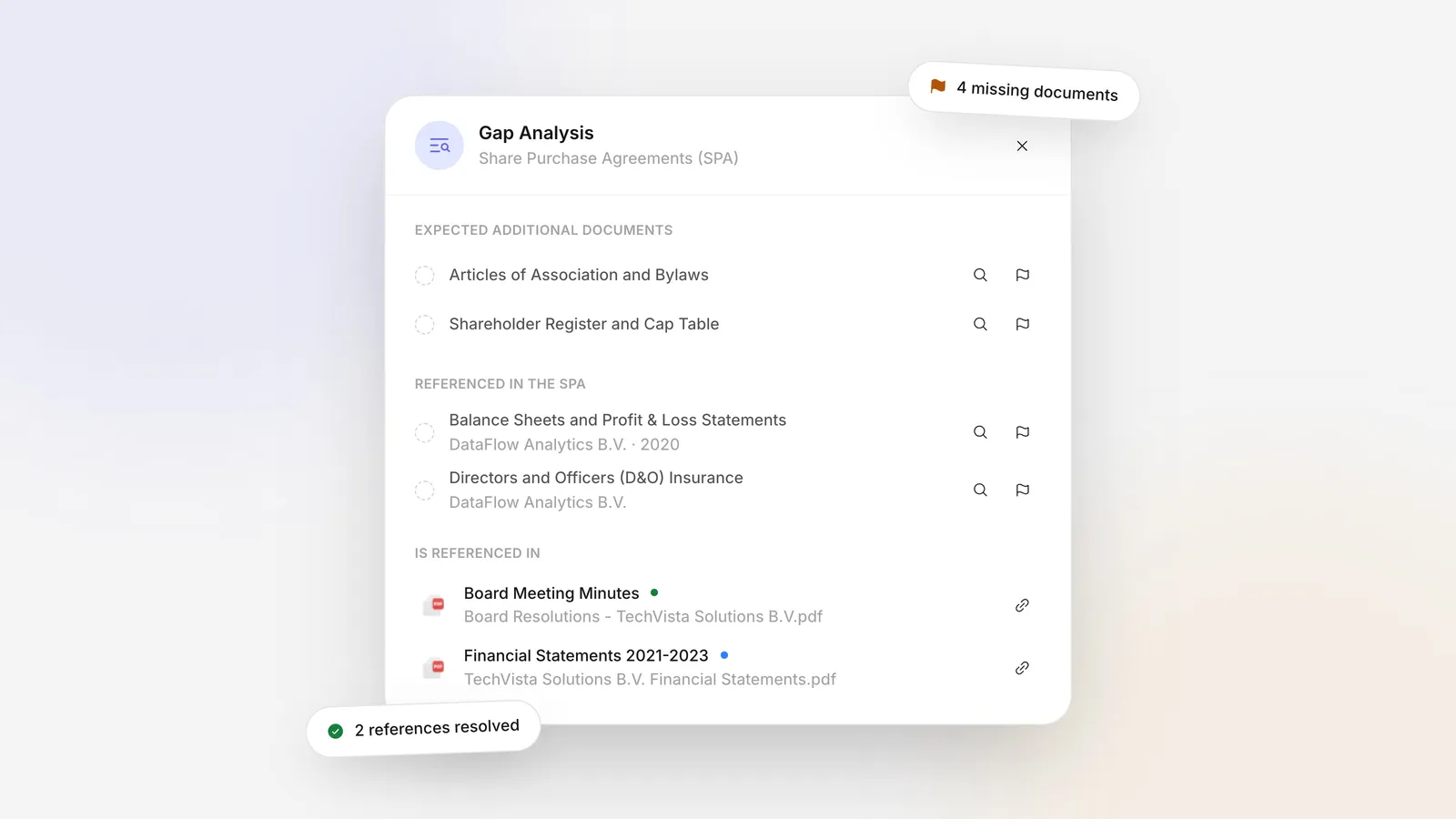
- Findings now flag references to documents missing from the data room
- Addenda and emails relating to specific contracts are automatically linked
- Risks are no longer flagged for stale documents that have been superseded by newer versions
Would you like to know more about Jurimesh, or are you interested in a demo? Contact us.